Food Brokers: The Hidden Growth Engine Driving Success in Today's FMCG Market
Discover why food brokers are essential to success in the modern FMCG industry and learn how AIETA Global helps brands grow through sourcing, logistics, distribution, and global market expansion.
Rachel Fitzpatrick
6/30/20263 min read
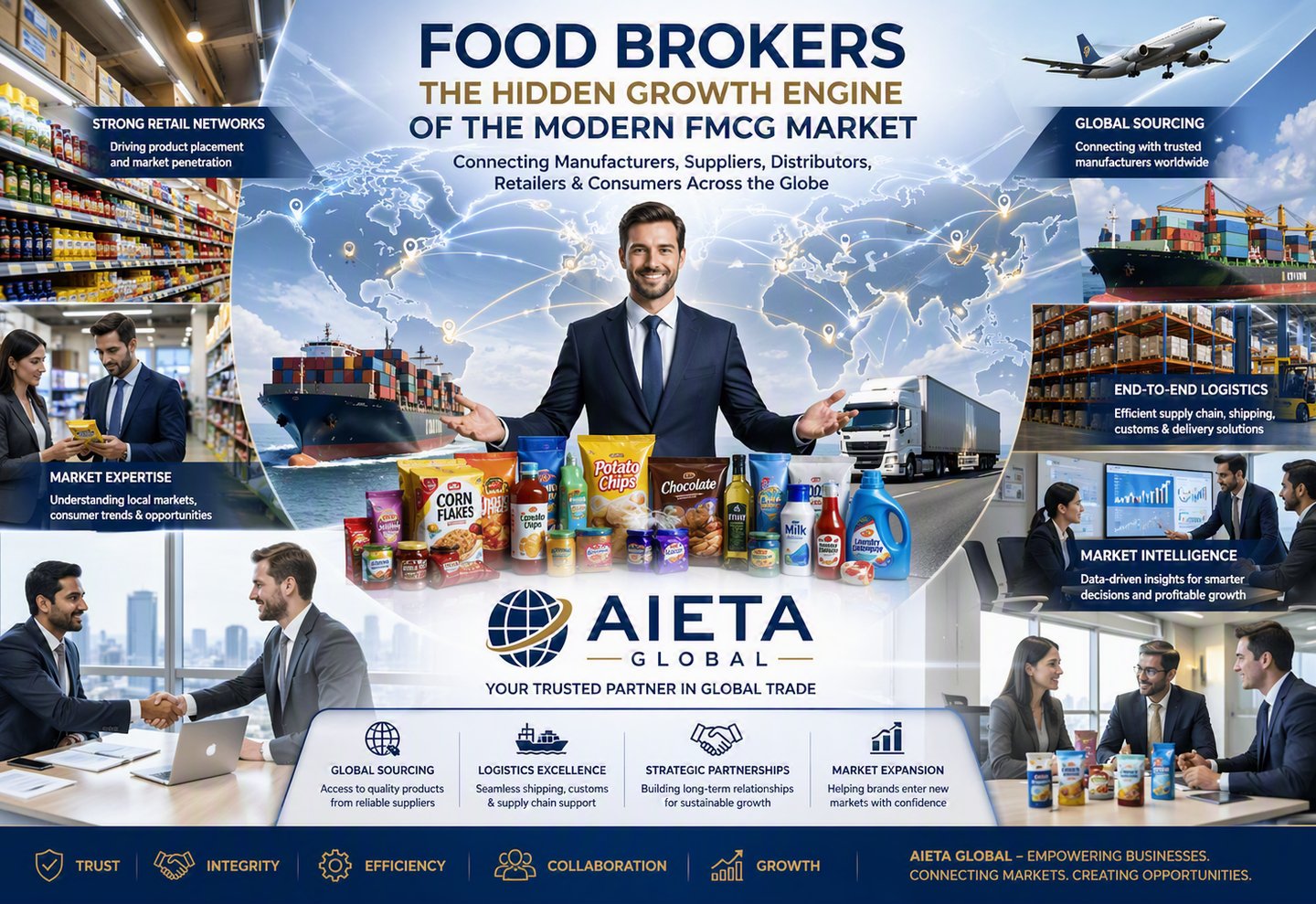
Food Brokers: The Hidden Growth Engine of the Modern FMCG Market and the Role of AIETA GLOBAL
Introduction
The Fast-Moving Consumer Goods (FMCG) industry is one of the most competitive and dynamic sectors in the global economy. With thousands of brands competing for shelf space, consumer attention, and distribution opportunities, manufacturers need more than just great products to succeed. They require strong market access, retail relationships, logistics expertise, and strategic guidance. This is where food brokers play a critical role.
Food brokers act as the bridge between manufacturers, distributors, wholesalers, and retailers, helping products move efficiently through the supply chain and reach consumers faster. As market complexity continues to grow, the importance of food brokers has never been greater.
What Is a Food Broker?
A food broker is a specialized sales and marketing intermediary that represents food and beverage manufacturers in the marketplace. Rather than selling directly to every retailer and distributor, manufacturers often partner with brokers who already possess strong industry relationships and market knowledge.
Food brokers typically help with:
Product placement and retail listings
Distributor management
Market expansion strategies
Promotional planning
Sales negotiations
Category management
Supply chain coordination
Market intelligence and trend analysis
Their expertise allows manufacturers to focus on product development and production while ensuring effective market penetration and sales growth.
Why Food Brokers Are Essential in Today's FMCG Market
1. Faster Market Access
Retail chains and distributors receive countless product proposals each year. Food brokers have established relationships with key decision-makers, enabling brands to secure meetings, product evaluations, and listing opportunities more efficiently.
For emerging brands, this access can significantly reduce the time required to enter new markets.
2. Cost-Effective Sales Expansion
Building an in-house sales force across multiple regions is expensive and time-consuming. Food brokers provide immediate market coverage without the overhead associated with recruiting, training, and managing large sales teams.
This makes them particularly valuable for small and medium-sized FMCG companies seeking rapid growth.
3. Local Market Expertise
Consumer preferences vary by geography, culture, and retail environment. Food brokers understand regional purchasing behavior, competitive dynamics, and retailer expectations.
Their market insights help manufacturers tailor products, packaging, pricing, and promotional strategies to specific target markets.
4. Strong Retail Relationships
Success in FMCG often depends on retailer partnerships. Food brokers maintain ongoing relationships with supermarkets, convenience stores, wholesalers, and specialty retailers.
These relationships can influence:
Product placement
Shelf positioning
Promotional opportunities
Inventory planning
New product launches
5. Supply Chain Efficiency
Modern FMCG supply chains are increasingly global and interconnected. Food brokers help coordinate sourcing, procurement, inventory management, transportation, and distribution activities to ensure products are delivered efficiently and cost-effectively.
Challenges Facing the FMCG Industry
Today's FMCG companies face several challenges:
Rising logistics costs
Supply chain disruptions
Increasing competition
Rapid consumer preference changes
Regulatory complexities
Global sourcing pressures
Retail consolidation
As these challenges intensify, businesses need partners capable of navigating complex international trade environments while maintaining operational efficiency.
How AIETA GLOBAL is Supporting FMCG Growth
AIETA Global has positioned itself as more than a traditional trading company. It operates as a global FMCG sourcing, consulting, and trade facilitation partner that connects manufacturers, distributors, importers, exporters, and retailers across international markets.
Global Sourcing Expertise
One of AIETA's core strengths is identifying reliable manufacturers and suppliers worldwide. The company specializes in sourcing FMCG products and connecting businesses with trusted supply partners across multiple regions.
This capability helps clients:
Reduce sourcing risks
Improve supplier quality
Access competitive pricing
Expand product portfolios
End-to-End Logistics Support
AIETA provides comprehensive import and export logistics solutions, including freight coordination, customs support, shipping management, and delivery services.
By simplifying logistics, AIETA enables businesses to focus on growth rather than operational complexities.
Market Connectivity
Similar to the role of modern food brokers, AIETA builds connections between buyers and sellers through its international network of suppliers, distributors, manufacturers, and exporters. The company emphasizes trade partnership facilitation and market access support.
This network-driven approach helps businesses enter new markets and establish sustainable distribution channels.
Strategic Consulting and Market Intelligence
AIETA also provides consultation on sourcing strategies, trade regulations, supply chain planning, and market expansion initiatives.
For FMCG companies, these services offer valuable insights into:
Market-entry opportunities
Compliance requirements
Supply chain optimization
International trade best practices
Building Long-Term Partnerships
Rather than focusing solely on transactions, AIETA promotes long-term strategic partnerships. Its business model centers on creating trusted relationships among global trading partners, helping clients build resilient and scalable supply chains.
The Future of Food Brokerage and FMCG Distribution
As FMCG markets become increasingly globalized, the role of food brokers and trade facilitators will continue to evolve. Success will depend on:
Data-driven decision making
Advanced supply chain visibility
Global sourcing capabilities
Retail relationship management
Market intelligence
Strategic partnerships
Organizations that combine traditional brokerage expertise with international trade capabilities will be best positioned to support FMCG growth in the coming decade.
Conclusion
Food brokers remain an indispensable part of the modern FMCG ecosystem. They accelerate market entry, strengthen retail relationships, optimize distribution networks, and provide the industry expertise required to compete in a fast-changing marketplace.
AIETA exemplifies this modern evolution by combining FMCG sourcing, logistics support, strategic consulting, and global trade facilitation into a comprehensive business solution. Through its international network and end-to-end services, AIETA helps manufacturers, distributors, and retailers overcome market barriers and unlock growth opportunities across global FMCG markets.
In an industry where speed, efficiency, and connectivity define success, food brokers and companies like AIETA are becoming critical enablers of sustainable growth and market expansion.
Stay Connected With Aieta Global Trading
Partnering worldwide to deliver seamless trade solutions. Reach out to us anytime —your gateway to global markets.
info@aietaglobal.com
281-410-5524